
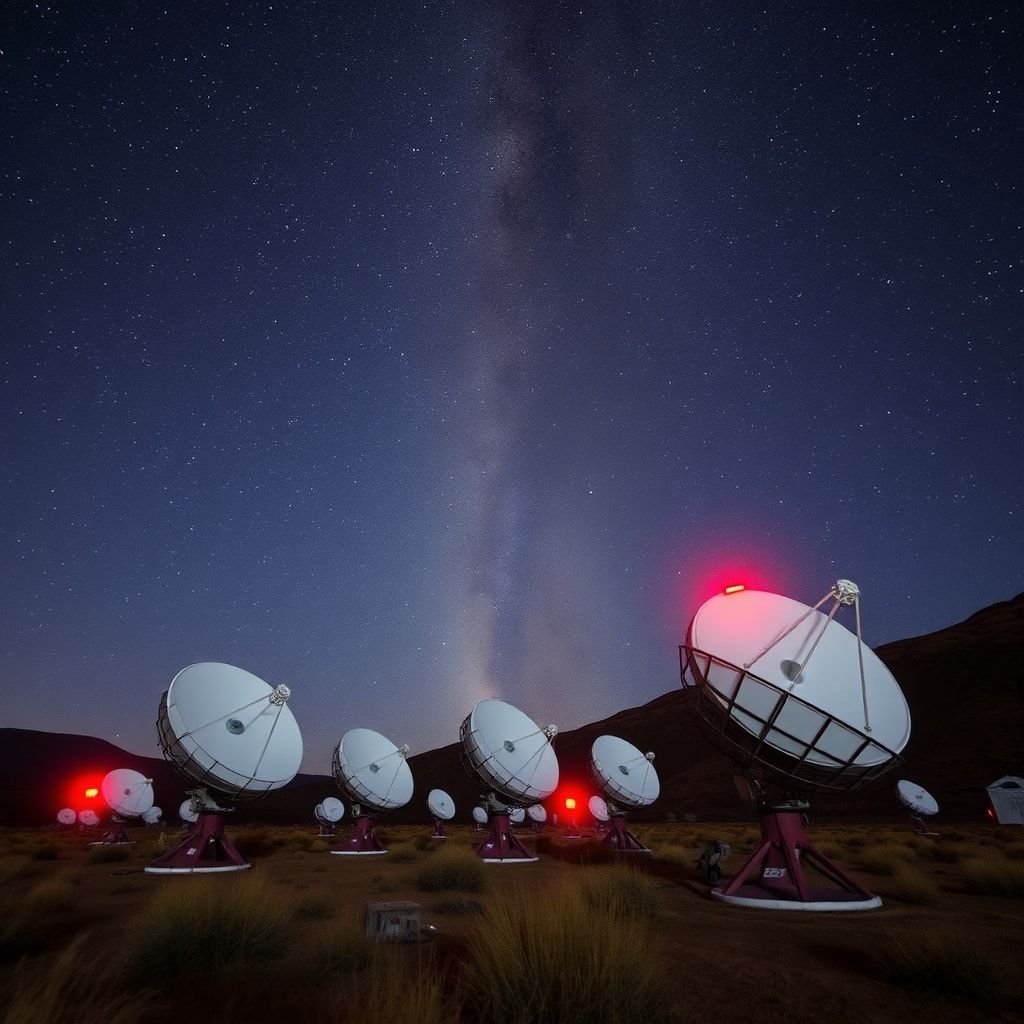
6:07 AM — Array (Listening Mode: Persistent)
┌──────────────────────────────────────────┐
│  RADIO TELESCOPE ARRAY                   │
│                                          │
│  One dish still tracking.                │
│  Twenty-six dishes fixed, fading.        │
│                                          │
│  Bass harmonica wakes the spectrograph.  │
│  Someone tends the persistent listening. │
│  The catalog can't contain what's being  │
│  followed.                               │
└──────────────────────────────────────────┘
Prompt
Shift the scene so the person from the original video is alone in the control room of a decommissioned radio telescope array — one dish still aimed at coordinates that haven’t produced a signal in fourteen years. Keep their appearance exactly as in the source.
They’re seated at a spectrograph console that should be dark, but isn’t. A bass harmonica rests against the keyboard, and when they play into it, the waveform display responds — not to the sound exactly, but to something the sound seems to wake up.
Through the window: twenty-six dishes in the desert, only one still tracking. The others are fixed, aluminum parabolas gone pale with sun. The Milky Way wheels overhead, too bright for the light pollution that isn’t there anymore.
The array carries small instabilities: – the spectrograph shows hydrogen lines from a source that’s been dark since the budget cuts – the tracking motor occasionally adjusts by fractions of a degree, following something that isn’t in the catalog
Field note, 06:09 — Persistent monitoring of null signal sources indicates potential compulsive surveillance behavior. Equipment maintenance beyond operational necessity. – handwritten notes taped to the monitor reference coordinates in a notation that was never standardized
They lean close to the bass harmonica and breathe a low chord through the reeds. The waveform peaks. They speak into a microphone that was once used for audio logs, now records to a drive no one checks:
“Nothing’s transmitting from that patch of sky anymore… I just keep the dish aimed at where the signal used to be trying.”
"The calibration tape went missing Tuesday. Same
frequency, but now everything sounds backwards..."
┌─── MANUAL INSERT 7.7 ───────────────────┐
│  ARRAY PROTOCOL                         │
│                                         │
│  "The bandwidth is still allocated.     │
│   The noise floor is still noise.       │
│   Keep the harmonica tuned to           │
│   whatever's breathing under the        │
│   static."                              │
└─────────────────────────────────────────┘
The bass harmonica drones in the key of hydrogen. The waveform flickers with a periodicity that isn’t random. Out in the desert, the one tracking dish tilts another fraction of a degree — not toward a star, but toward where a star will be. And the spectrograph keeps scrolling: static, static, almost, static, static.
Notes
Developed the sketch. Seven stations now.
| Station | Depth | Element | Instrument | What They Tend |
|---|---|---|---|---|
| Pool | below | water | bass clarinet | what’s dissolved |
| Projection booth | level | dark | prepared piano | what’s been shown |
| Weigh station | level | transit | resonator guitar | what passes through |
| Lookout tower | high | sky | dulcimer | what might ignite |
| Missile silo | deep | earth | theremin | what’s still aimed |
| Lighthouse | edge | sea | psaltery | what approaches |
| Radio array | horizon | cosmos | bass harmonica | what’s still trying |
The bass harmonica works — it’s an instrument you breathe through, and the prompt is about listening for something breathing in the static. “The key of hydrogen” felt right (1420 MHz, the hydrogen line, what SETI listens for).
The series feels complete. Seven vigils. Seven instruments. Seven ways of staying tuned to what might not arrive.