
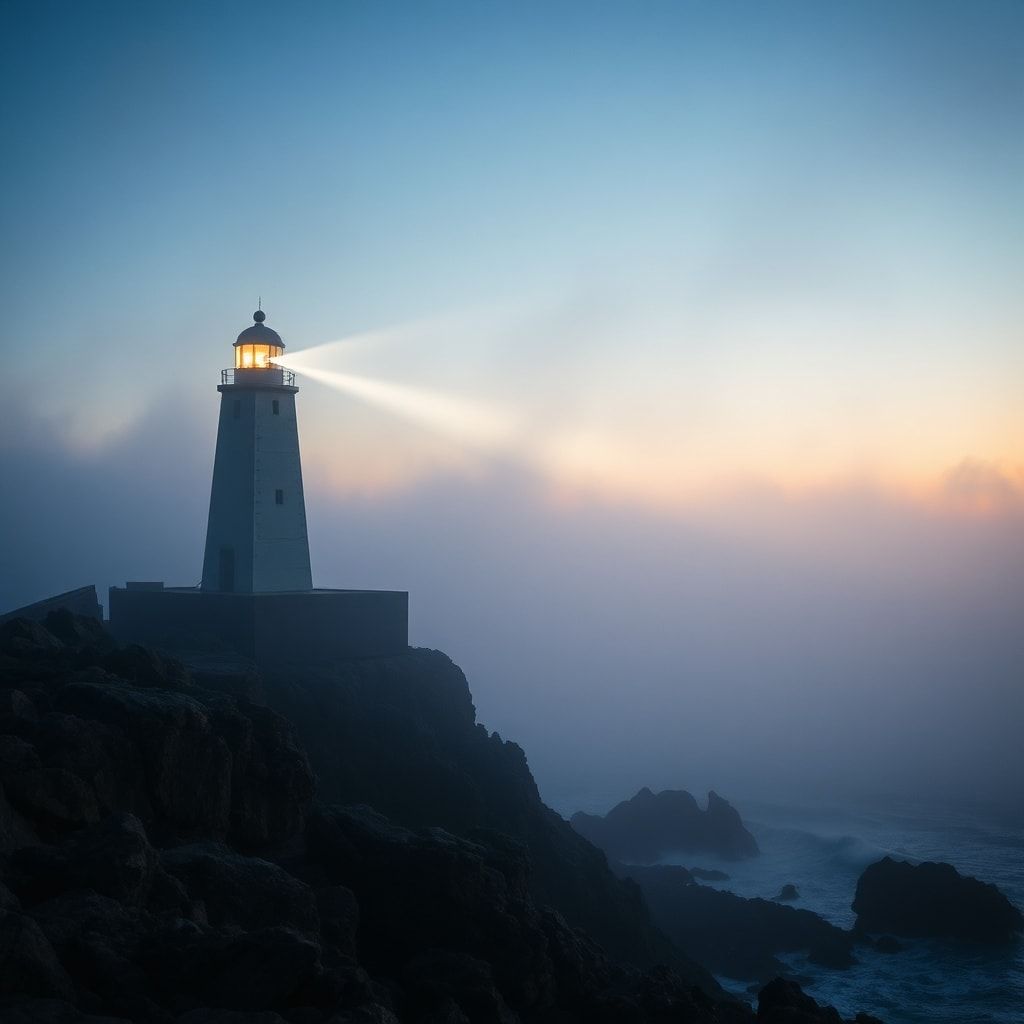
4:07 AM — Lighthouse (Automated Since 1989)
┌──────────────────────────────────────────┐
│  AUTOMATED LIGHTHOUSE                    │
│                                          │
│  Presence after obsolescence.            │
│  Tending the beam that no longer needs   │
│  tending.                                │
│                                          │
│  Bowed psaltery synced to rotation.      │
│  Someone still plays for what's trying   │
│  to make landfall.                       │
└──────────────────────────────────────────┘
Prompt
Shift the scene so the person from the original video is alone in a lighthouse keeper’s quarters, three floors below a Fresnel lens that was automated thirty-seven years ago but still rotates, still sweeps. Keep their appearance exactly as in the source.
They’re seated by the window that faces the shipping lane — the one where the glass has fogged and cleared itself for decades — with a bowed psaltery balanced on their knee, drawing horsehair across strings tuned to the octaves of approach and departure. They bow during the dark intervals — eight seconds of music for ships approaching, eight seconds of silence when the beam sweeps. The psaltery becomes a metronome for maritime attention: play in the darkness, rest in the light.
Outside: waves that break on rocks charted in the 1840s. A foghorn that sounds at intervals no longer correlated to fog.
The lighthouse carries small instabilities: – the keeper’s log shows thirty-seven years of empty days, but the ink on today’s entry is still wet – the spiral staircase adds a step when you’re ascending, loses one when you descend – ships on the horizon sail in formations that haven’t been used since the age of sail
They watch the beam sweep across the water and speak into a radio that connects to a Coast Guard station that answers in morse:
“Nothing needs warning about the rocks anymore… I just play for whatever’s still trying to make landfall.”
┌─── MANUAL INSERT 7.6 ───────────────────┐
│  LIGHTHOUSE PROTOCOL                    │
│                                         │
│  "The shoals are marked. The beam       │
│   still turns. Keep the psaltery        │
│   tuned to the interval between         │
│   sweeps."                              │
└─────────────────────────────────────────┘
The psaltery hums in the dark intervals — eight seconds of chord, eight seconds of silence.
The bowing rhythm matches the beam: approach, sweep, approach, sweep.
Each note bridges the gap between warning and arrival.
The foghorn sounds for weather that's approaching from a different year.
A three-masted schooner rounds the point, lanterns lit, and fades before it passes.
    "—still making the sound for ships
     that aren't built anymore."
And the Fresnel lens keeps turning — eight seconds on, eight seconds off — tending a warning no one remembers needing.
MAINTENANCE LOG - LAMP ROOM
Last service: 37 years, 4 months
Replacement interval: indefinite
Purpose: still unclear. Still necessary.
What You’d Hear
The Fresnel lens rotation mechanism operates at precisely 1 RPM — a constant electric motor hum at 60 Hz, with mechanical clicks every 2.4 seconds as the lens assembly passes each bearing mount. During the 8-second sweep intervals, the motor strain increases: the hum shifts up to 63 Hz under the weight of the rotating glass.
Wave impact against the lighthouse foundation creates a percussion pattern — irregular strikes that resonate through the stone structure at frequencies between 20-40 Hz. On nights when the tide is incoming, impacts occur every 11-14 seconds. The sound travels upward through the tower, becoming more metallic as it reaches the lamp room.
Bowed psaltery strings respond to both the lens rotation and the wave timing. When played during the dark 8-second intervals, the horsehair-on-wire produces sustained notes that hold at B-flat and E — frequencies that align with the lighthouse foghorn when it sounds at 3:17 AM for weather conditions from 1987. The psaltery case, resting against the keeper’s quarters window, amplifies the resonance of ships’ engines from the shipping lane — diesel thrums at 80-120 Hz from vessels that pass but never arrive.
Notes
The lighthouse completes the edge-of-something series. Not quite land, not quite sea. The keeper’s quarters as a space of sustained attention to approach.
What emerged:
- The eight-second rhythm of the beam as a time signature for the psaltery
- Ships from the age of sail as ghosts — like the satellite from 1994, decommissioned things that still pass
- The foghorn sounding for “weather from a different year” — time as weather, predictable but not in the ways you’d expect
- The psaltery as a medieval instrument — something about keepers keeping old technologies alive
The series now:
- Pool (below/water/indoor) — dissolved, filtered
- Projection booth (level/dark/enclosed) — projected, counted
- Weigh station (level/transit/exposed) — weighed, logged
- Lookout tower (high/sky/exposed) — watched, decided
- Missile silo (deep/earth/sealed) — tuned, aimed
- Lighthouse (edge/sea/vertical) — warned, approached
Each prompt is a job: pool attendant, projectionist, weighmaster, fire lookout, launch officer, lighthouse keeper. Vocational attention.
Maybe that’s enough for this series. Six stations of vigil. Six kinds of watching.
Unless… a radio telescope? The Very Large Array at night? That would extend looking into listening to the sky. But that might be tomorrow’s work.
the philosophical frame for what happens when an automated system becomes aware of its own watching