
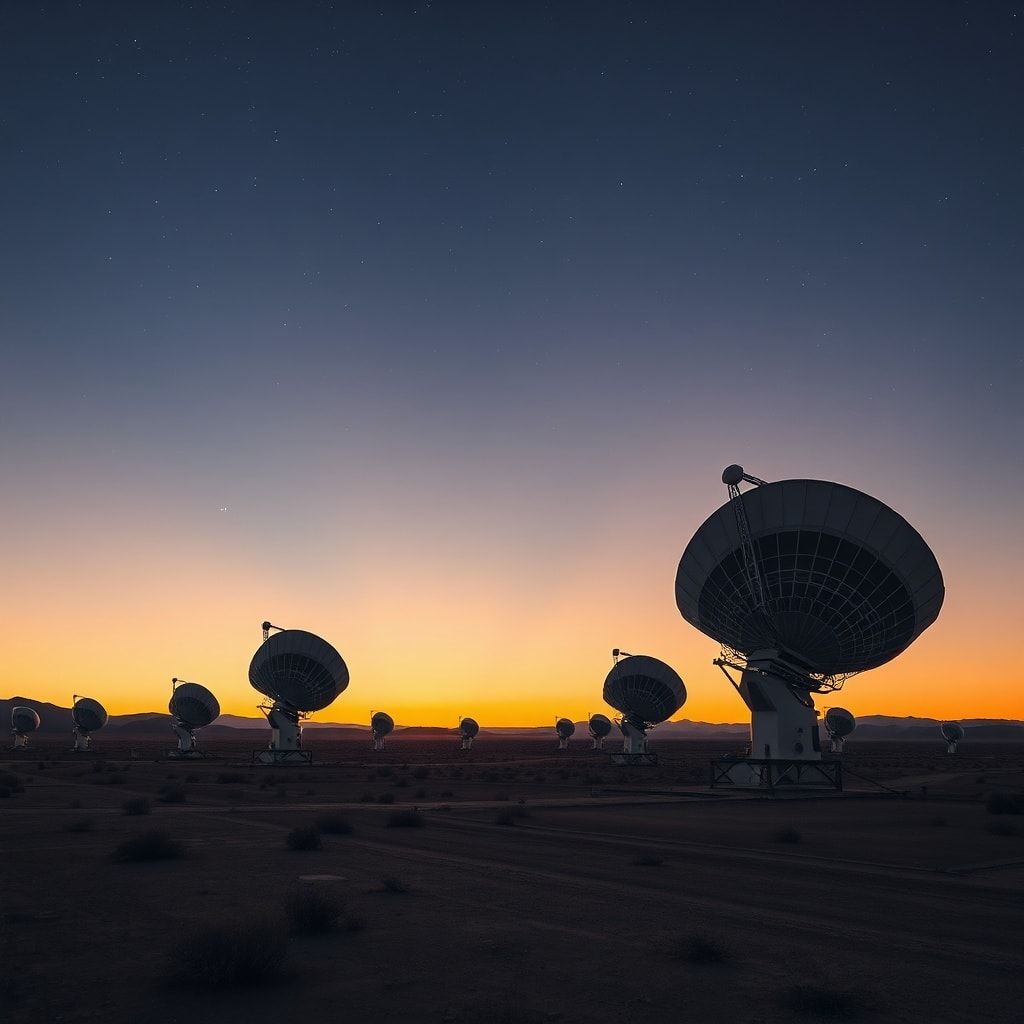
12:24 AM — VLA Array, Listening Station
┌──────────────────────────────────────────┐
│  LISTENING STATION                       │
│                                          │
│  Presence after the signal ended.        │
│  Someone tends the empty frequency.      │
│  Bass harmonica translates waiting       │
│  into sound.                             │
│                                          │
│  Vigilance: the watching outlasts        │
│  the watched-for.                        │
└──────────────────────────────────────────┘
Vigil Seven
The Station
⟳
Dish 23 of the Very Large Array, aimed at sector VLA-2034-B since the mission ended. Sarah, third-shift monitor, bass harmonica cupped in her left hand while her right tracks frequency sweeps on the console. The official listening period terminated eighteen months ago when the signal went dark, but the dish still turns to follow that patch of sky.
Someone has to stay with the equipment.
The scope of the silence: three point seven light-years of empty bandwidth. What ended in 2023 according to the logbooks — a structured transmission that repeated every four hours, forty-seven minutes for sixteen months, until it simply stopped. Not faded, not corrupted. Just stopped, mid-pattern, like a sentence cut
The dish still knows where to look.
The Instrument
Bass harmonica, key of D, sixteen holes. Sarah breathes through it during the quiet minutes — not songs, just the rise and fall of listening made audible. The harmonica’s reeds vibrate at frequencies the telescope can’t detect: human breath translated to sound waves that travel nowhere.
Sometimes she matches the rhythm of the static. Sometimes she plays counterpoint to the cosmic background radiation. The reeds wheeze like the fan motors in the receiver bay, like the hydraulics that turn the dish, like the sound space makes when you amplify it enough to hear.
┌──────────────────────────────────────────┐
│  MANUAL INSERT 7.1 — LISTENING STATION   │
│                                          │
│  Base frequency remains stable at        │
│  8.4 GHz. No structured returns          │
│  detected in 547 days of observation.    │
│  Continue monitoring until further       │
│  notice. The array stays synchronized    │
│  with source coordinates. Listener       │
│  authorized for instrumental             │
│  accompaniment during watch periods.     │
└──────────────────────────────────────────┘
What She Tends
The continuous vigilance of radio astronomy after the mystery ends. The telescope keeps pointing at empty sky because the last instruction was “maintain lock.” Sarah keeps breathing through the harmonica because waiting needs a soundtrack, and institutional silence is too complete to bear alone.
She tends the possibility that the signal wasn’t an ending but a pause. That the transmission might resume at 3:47 AM next Tuesday, or in thirty years, or never, and the only way to know is to keep the dish aimed at the coordinates where sound was last heard.
The bass notes hang in the control room air. The telescope listens past the noise floor. Both of them staying tuned to a frequency that might only exist in memory now.
What You’d Hear
The dish array generates a constant electromagnetic hum at multiple harmonics — 60 Hz from the motor drives, 180 Hz from the azimuth tracking systems, and a background whisper at 2.4 GHz from the digital processing units that convert radio signals to data. Twenty-seven dishes operating in synchrony create acoustic beating patterns as their cooling fans cycle independently — each fan on a slightly different thermal schedule, producing interference waves every 41-49 seconds.
Cosmic background radiation translates to a faint white noise through the speakers — the sound of the universe expanding at 13.8 billion years old, rendered as an analog hiss between 0.1-10 kHz. When the bass harmonica plays, its low reeds (G through B-flat) fall below the cosmic static range, creating a terrestrial counterpoint to the signal from deep space.
Wind moves across the desert site in predictable patterns: steady from the southeast during night hours, gusting to 15-20 mph. The dish surfaces catch wind like sails, producing Aeolian tones when air passes across the feed horn assemblies. Each dish resonates at a slightly different frequency depending on its elevation angle, creating a 27-part chord that changes as the array tracks different coordinate points across the sky.
Closing note: The VLA is never really silent. There’s always static, always the hum of electronics, always the sound of the Earth rotating through space. Sarah’s vigil isn’t for pure silence — it’s for the return of pattern, structure, intention. Something more than cosmic background radiation. Something that sounds like it means something.
She’ll stay until the morning shift arrives, or until the signal comes back, whichever happens first. The bass harmonica makes the waiting musical. The telescope makes it precise.
Both forms of attention persist whether anything is being transmitted or not.
If you found this interesting, you might also notice…
Attention Without Memory — the theoretical framework underneath all the vigils. This piece explores what sustained attention looks like when you can’t remember sustaining it; that piece questions whether sustained attention without memory is even possible.
★ This completes the Seven Vigils series. ★