James Hollis: The Psychology of Masculine Wounding and the Failure of Initiation
Overview
James Hollis, Ph.D. (b. 1940) is a Zurich-trained Jungian analyst practicing in Washington, D.C., and the author of twenty-two books on depth psychology, meaning-making, and the examined life. His work occupies a distinctive niche: he writes for educated general readers, translating the dense clinical and mythological language of Jung into accessible prose about ordinary human suffering and development. Where many Jungian writers remain cloistered in symbolic interpretation, Hollis brings the framework down to the lived experience of people stuck in unfulfilling marriages, dead-end careers, depression, and the quiet desperation of unlived lives.
His most relevant work for our purposes is Under Saturn’s Shadow: The Wounding and Healing of Men (1994), which directly addresses the psychological consequences when cultures fail to initiate boys into manhood. But his broader body of work — especially The Middle Passage (1993), Swamplands of the Soul (1996), Finding Meaning in the Second Half of Life (2005), and What Matters Most (2009) — develops a comprehensive framework for understanding what happens psychologically when the structures that once carried people through life’s transitions collapse.
If Margaret Mead showed us that every culture must construct masculinity through deliberate means, Hollis shows us what happens inside the individual psyche when that construction fails.
Biographical Context
Hollis came to Jungian analysis relatively late. He earned his Ph.D. in humanities (not psychology), taught at various universities, and only trained as an analyst at the C.G. Jung Institute in Zurich, Switzerland in mid-life. This trajectory matters: he experienced the “middle passage” he writes about. He wasn’t theorizing from a position of professional comfort but from his own encounter with the collapse of the provisional personality.
He has been Executive Director of the Jung Educational Center in Houston, Texas, and later practiced in Washington, D.C. His most recent work includes a co-authored book with artist Enrique Martinez Celaya, Tending the Fire: Creativity, Purpose, and the Unfolding Self, and a 23-minute documentary film with filmmaker José Enrique Pardo on the wounding and healing of men (available at soulhealfilm.com). The film’s stated purpose: “to stimulate reflection and initiate dialogue around the troubled condition of many, if not most, modern men.”
That phrase — “many, if not most” — is quintessential Hollis. He does not treat masculine suffering as exceptional or pathological. He treats it as the predictable consequence of a culture that has no idea how to make men.
Core Framework: The Provisional Personality
What It Is
The provisional personality is the adaptive self constructed in childhood and adolescence to survive within a family system and cultural context. It answers the critical question: What does this family need me to be?
$ check_personality --status
> Personality: PROVISIONAL
> Version: Child_Survival_2.3.1
> Last Update: Age 7
> Dependencies: Family approval, cultural fitting-in
> Warning: System becoming increasingly unstable
> Recommend: Major upgrade or complete rebuild
$ ignore_warning
> Warning suppressed. Will check again in 10 years.
``` What gets me love? What gets me punished? What must I suppress to belong? The answers to these questions become the operating system of the first half of life.


  The provisional personality as a constructed container for survival and adaptation


The provisional personality is not pathological. It's necessary.

For men specifically, the provisional personality typically includes:

- **Performance orientation** — worth defined by achievement, productivity, earning
- **Emotional suppression** — vulnerability coded as weakness, leading to the characteristic male inability to name or express feelings
- **Role identification** — "I am what I do" rather than "I am who I am"
- **Power as substitute for authority** — external control compensating for internal uncertainty
- **Relational instrumentalism** — relationships as functional arrangements rather than intimate connections

### The Problem

The provisional personality works — until it doesn't. Hollis argues that for most people, the first major crisis of the provisional personality arrives somewhere between ages 35 and 50 (though it can come earlier through trauma, loss, or forced disruption). The structures that carried you through young adulthood — career identity, relational patterns, beliefs about how the world works — begin to feel hollow, constraining, or simply false.

This is not a "midlife crisis" in the trivializing popular sense. Hollis calls it the **Middle Passage**: a psychological crossing from the first half of life (building the ego, establishing the provisional personality) to the second half of life (dismantling what is false and discovering what is authentic).

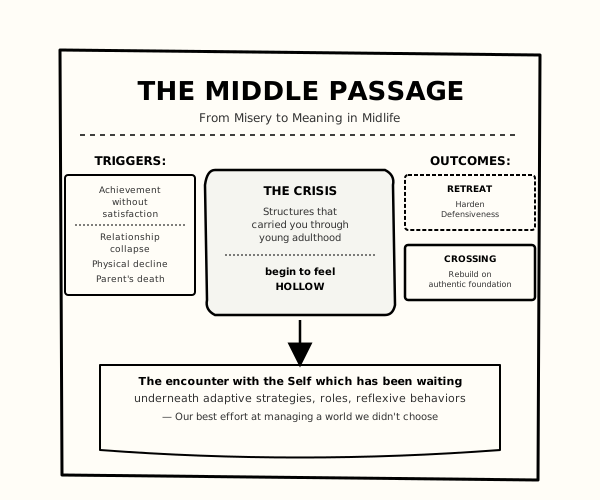
> The Middle Passage is "the encounter with the Self which has been waiting all along, underneath the adaptive strategies, the roles, the reflexive behaviors that were our best effort at managing a world we didn't choose and couldn't control."

### Why It Matters for Masculinity

The provisional personality is particularly devastating for men because:

1. **Men are given fewer emotional resources.** Boys are socialized to suppress the very feelings that would signal when the provisional personality is failing. A woman might feel depression or anxiety as a signal; a man is more likely to act out through workaholism, addiction, affairs, or rage — all of which are further expressions of the provisional personality rather than escapes from it.

2. **Male identity is more externally referenced.** Because masculinity must be culturally constructed (as Mead demonstrated), and because modern culture does an increasingly poor job of this construction, men are more likely to confuse the provisional personality with their actual identity. "If I'm not the provider/achiever/tough guy, who am I?"

3. **The collapse of the provisional personality feels like death.** And for men taught that showing vulnerability is unacceptable, this psychological death is endured alone, without witness or container.

---

## _Under Saturn's Shadow_: The Wounding and Healing of Men (1994)

This is Hollis's most direct treatment of masculine psychology and the book most relevant to our research thread connecting Mead's cross-cultural observations to individual psychological consequences.

### Saturn as Metaphor

The title invokes Saturn — the Roman god associated with time, limitation, melancholy, and the devouring father. In astrological and mythological tradition, Saturn represents the principle of restriction, duty, depression, and the weight of the world. Hollis uses Saturn as a metaphor for the particular quality of masculine suffering: heavy, silent, endured rather than expressed, pressing down from above.

Living "under Saturn's shadow" means living beneath the weight of:

- Expectations you didn't choose
- A father's unlived life projected onto the son
- Cultural definitions of manhood that were never examined
- The accumulated grief of an uninitiated life

### The Eight Secrets Men Carry

Hollis structures much of the book around what he calls the "secret" inner lives of men — the things most men feel but cannot speak:

1. **Men's lives are as much governed by role expectations as women's.** The feminist movement correctly identified how women were constrained by gender roles, but the equivalent insight for men has been slower to arrive. Men are just as trapped — perhaps more so, because the trap is less visible and less socially acceptable to name.

2. **Men's lives are governed by fear.** Not the fear of physical danger (which men are trained to face) but deeper fears: fear of inadequacy, fear of being unmasked as not enough, fear of emotional exposure, fear of other men's judgment. This fear is the engine of the provisional personality.

3. **Men carry an enormous amount of grief.** The unlived life, the absent father, the unexpressed tenderness, the paths not taken — all accumulate as silent grief that has no culturally sanctioned outlet. Men are not given permission to mourn what they have lost or never had.

4. **Men are lonely.** Not in the sense of lacking social contact, but in the deeper sense of having no one to whom they can show their actual inner life. Male friendships, even close ones, are typically organized around shared activity rather than emotional intimacy.

5. **Men are afraid of women.** Not physically, but psychologically — afraid of the emotional demands that expose their inadequacy, afraid of the feminine (both in women and in themselves), afraid of being consumed by the mother archetype's power.

6. **Men don't know who they are.** Having constructed a provisional personality around role and performance, most men have no access to their deeper nature. The question "What do you actually want?" is genuinely unanswerable for many men.

7. **Men carry their fathers' unlived lives.** The psychological burden of the father — his disappointments, his unfulfilled ambitions, his emotional absence — is transmitted to the son as a weight, a template, or a negative space that shapes the son's life from within.

8. **Men suffer primarily in silence.** The very code of masculinity that is supposed to make men strong ensures that their suffering remains invisible — to others and often to themselves.

### The Absent Father / Father Wound

Hollis identifies three primary forms of the father wound: the literally absent father (through death, divorce, abandonment, or workaholism), the emotionally absent father (physically present but psychologically unavailable), and the negative father (abusive, critical, or shaming). In all cases, the essential paternal function is missing — the opportunity to model what it means to be an adult man and to demonstrate that strength and emotional depth are not contradictory.


  The three types of father wounds and their shared consequence


Hollis's treatment of the father wound is perhaps his most psychologically penetrating contribution.

The consequences of the father wound include:

- **The puer aeternus (eternal boy)** — the man who never grows up, perpetually seeking the next adventure/relationship/career rather than committing to depth
- **Identification with the negative father** — unconsciously repeating the father's patterns of absence, abuse, or emotional shutdown
- **Compensation through the mother complex** — seeking in romantic partners the nurturing the father failed to provide, creating dependent relationships that infantilize both partners
- **The senex pattern** — prematurely old, rigidified, overly responsible, carrying the world's weight without joy or spontaneity

### Uninitiated Men

Here Hollis directly engages the anthropological territory that Mead mapped. He argues that traditional cultures understood something modern culture has forgotten: **boys do not become men automatically.** The transition must be:

1. **Witnessed** — by elder men who have themselves been through the passage
2. **Ritualized** — through a structured ordeal that marks a genuine boundary between boyhood and manhood
3. **Taught** — through transmission of the tribe's accumulated wisdom about what it means to be a man
4. **Blessed** — through the explicit recognition by the community that the boy has become a man

Without these elements, Hollis argues, men remain psychologically adolescent regardless of their biological age. They may accumulate power, wealth, and status, but they lack the inner authority that comes from genuine initiation. The result is what he calls **"the uninitiated male"**: a man who:

- Confuses power with authority
- Cannot tolerate ambiguity or uncertainty
- Reacts to challenge with defensiveness rather than openness
- Seeks external validation compulsively
- Cannot be alone without distraction
- Cannot provide for others the very initiation he himself never received

> "The chief horror of our time is that we are surrounded by leaders who are essentially uninitiated men — who confuse power with authority, control with leadership, and domination with strength."

### The Path of Healing

Hollis does not prescribe a program. His approach is characteristically Jungian: the healing comes through **consciousness** — becoming aware of the patterns, naming the wounds, and choosing to live differently. Specifically:

- **Acknowledging the wound.** Men must first admit that they are wounded — which requires overcoming the provisional personality's insistence that admitting vulnerability is weakness.
- **Grieving what was lost.** The absent father, the missing initiation, the unlived life — these must be mourned, not rationalized away or compensated for.
- **Withdrawing projections.** Men must stop expecting women, children, work, or achievements to fill the inner emptiness. The work is internal.
- **Encountering the shadow.** The parts of themselves that men have suppressed — tenderness, creativity, vulnerability, spiritual longing — must be integrated.
- **Finding or creating mentors.** In the absence of cultural initiation, men must seek out older men who have done their own work and can model authentic masculinity.
- **Doing the inner work.** Analysis, dreamwork, journaling, honest self-examination — the unglamorous daily practice of paying attention to one's inner life.

---

## The Swamplands of the Soul (1996)

This book extends Hollis's framework beyond masculinity to the universal human experience of suffering. But its relevance to our topic is profound: Hollis reframes depression, grief, loss, betrayal, and other forms of suffering not as pathologies to be eliminated but as **initiatory experiences**.

### The Central Argument

Modern Western culture treats suffering as a problem to be solved — through medication, therapy, distraction, or positive thinking. Hollis argues that this approach, while sometimes necessary, misses the deeper function of suffering: **it is the psyche's way of forcing growth.**

The "swamplands" — his metaphor for depression, anxiety, grief, guilt, betrayal, addiction, and other dark experiences — are not places to escape from but **places to pass through.** They are, in a sense, the modern equivalent of the ritual ordeals that traditional cultures imposed on initiates.

### The Swamplands as Modern Initiation

Where traditional cultures designed initiatory ordeals — scarification (Iatmul), fasting, isolation, encounters with death — modern individuals encounter their initiations through:

- **Depression** — the psyche's refusal to continue living a false life; a shutdown of the provisional personality
- **Grief and loss** — forced encounters with the reality of limitation and mortality
- **Betrayal** — the collapse of trust that forces a more realistic, mature engagement with the world
- **Addiction** — a misguided attempt to fill the spiritual emptiness left by the absence of genuine initiation
- **Midlife crisis** — the eruption of the unlived life, demanding attention

Hollis's insight: **these experiences function as initiation whether or not the person recognizes them as such.** The difference is that traditional cultures provided containers (ritual, community, elder guidance) for these experiences, while modern individuals typically endure them alone and interpret them as personal failures.

> "What our ancestors experienced as the gods, we moderns experience as symptoms."

---

## The Middle Passage: From Misery to Meaning in Midlife (1993)

### The Two Halves of Life

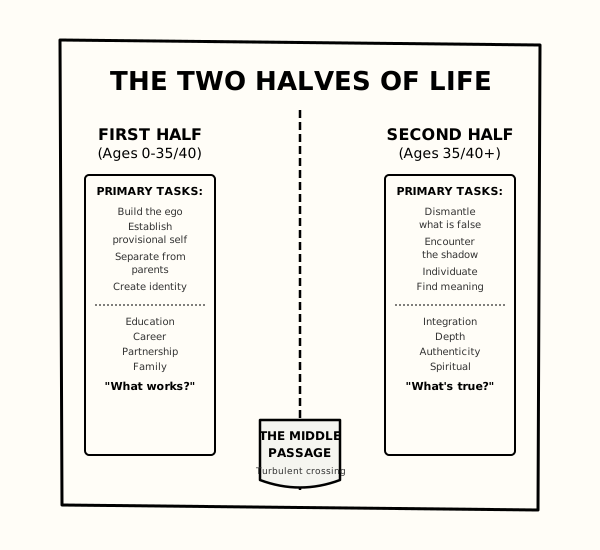
Drawing on Jung's model, Hollis describes two fundamentally different psychological tasks:


  The two fundamentally different psychological tasks of the first and second halves of life


**First half of life (approximately ages 0-35/40):**

- Building the ego
- Establishing the provisional personality
- Achieving separation from parents
- Creating a functional identity in the world
- Tasks: education, career, partnership, family

**Second half of life (approximately ages 35/40 onward):**

- Dismantling what is false in the provisional personality
- Encountering the shadow (suppressed aspects of self)
- Individuating — becoming who you actually are rather than who you were trained to be
- Finding meaning beyond ego achievement
- Tasks: integration, depth, authenticity, spiritual development

The **Middle Passage** is the turbulent crossing between these two phases. It is not a single event but a protracted psychological process — sometimes lasting years — in which the structures of the first half of life crumble and the person must either rebuild on a more authentic foundation or retreat into a hardened, defensive version of the provisional personality.

### How This Applies to Men

For men, the Middle Passage is often triggered by:

- Career achievement that brings success but not satisfaction ("Is this all there is?")
- Relationship collapse that exposes the emotional emptiness beneath functional partnerships
- Physical decline that undermines identity built on strength, vitality, or attractiveness
- The death of a parent — especially the father — that forces confrontation with one's own mortality and unlived life
- Children leaving home, removing the role of "provider" that had defined identity


  The middle passage as a crisis of meaning and the encounter with the Self


Hollis observes that men are particularly likely to resist the Middle Passage because the provisional personality tells them that what they're feeling is weakness, and the culturally sanctioned response to weakness is to work harder, push through, and suppress.

The men who navigate the Middle Passage successfully are those who can:

- Tolerate the depression and confusion without medicating it away
- Ask themselves what the psyche is trying to communicate
- Risk vulnerability with at least one other person
- Accept that the first half of life's achievements, while real, are not sufficient for meaning

---

## Finding Meaning in the Second Half of Life (2005)

### The Core Question

Hollis frames the second half of life around a deceptively simple question: **"Does this path, this relationship, this project enlarge me or diminish me?"**

This question replaces the first-half-of-life questions ("Will this make me successful? Will this make others approve of me? Is this what I'm supposed to do?") with a criterion that comes from within rather than without.

### Individuation vs. Individualism

Hollis is careful to distinguish Jungian **individuation** from Western **individualism**:

- **Individualism** is the ego's project — pursuing personal desires, accumulating personal success, declaring independence from others
- **Individuation** is the Self's project — becoming psychologically whole by integrating what has been rejected, suppressed, or unlived; it typically involves _more_ connection to others, not less, because the individuating person is no longer relating from need but from authentic engagement

For men who have built their identity on individualistic achievement, this distinction is crucial. The second half of life is not about achieving more but about becoming more — more honest, more emotionally present, more capable of genuine intimacy, more willing to face the shadow.

### The Examined Life in Practice

Hollis offers what he calls "big questions" — not as a self-help program but as ongoing practices of self-examination:

1. Where has my life been too small? Where have I been playing it safe?
2. What is my shadow — what have I rejected, suppressed, or projected onto others?
3. Where am I living someone else's life — my parents', my culture's, my partner's expectations?
4. What would I do if I weren't afraid?
5. What does my soul want, as opposed to what my ego wants?
6. Where am I using power when what is needed is vulnerability?
7. What must I leave behind in order to go forward?

---

## What Matters Most: Living a More Considered Life (2009)

This later work synthesizes Hollis's decades of clinical practice into a meditation on what constitutes a meaningful life. Key themes:

- **The "considered life"** vs. the reactive life — most people live reactively, driven by the provisional personality's programming, never stopping to examine whether their life reflects their actual values
- **The difference between happiness and meaning** — Hollis, following Jung and Frankl, argues that pursuing happiness directly is a fool's errand; meaning is the proper goal, and meaning often requires passing through suffering
- **Vocation vs. career** — a career is what you do for money and status; a vocation (from Latin _vocare_, to call) is what the soul demands of you, regardless of external reward
- **The necessity of solitude** — genuine selfhood requires the capacity to be alone, to face oneself without distraction, which most modern people (and most men especially) systematically avoid

---

## Hollis in the Mythopoetic Tradition

Hollis's work exists alongside but distinct from the "mythopoetic men's movement" of the 1990s associated with Robert Bly (_Iron John_, 1990), Michael Meade (_Men and the Water of Life_, 1993), and others. Key comparisons:

### Shared Ground

- All draw on Jungian psychology and mythological frameworks
- All emphasize the absence of male initiation in modern culture
- All identify the father wound as central to male suffering
- All argue that masculinity must be consciously constructed
- All use story, myth, and image rather than pure clinical language

### Where Hollis Differs

- **Less romantic about "wildness."** Bly's _Iron John_ celebrated the "Wild Man" archetype — the untamed masculine energy that civilization suppresses. Hollis is more cautious: he recognizes that the shadow contains destructive as well as creative energies, and that "liberation" without consciousness can be as damaging as repression.
- **More clinical depth.** Hollis writes from decades of analytic practice with individual men, giving his work a specificity and psychological precision that the mythopoetic movement sometimes lacked.
- **Less prescriptive.** Bly and Meade often led large group rituals, drumming circles, and wilderness retreats as forms of modern initiation. Hollis is skeptical of programmatic approaches: he believes genuine transformation comes through the slow, unglamorous work of individual self-examination, not weekend warrior experiences.
- **More emphasis on the second half of life.** The mythopoetic movement often focused on young men's initiation. Hollis's primary audience is men in midlife and beyond — men who have already "succeeded" by conventional measures and find it hollow.

---

## Connection to Mead: The Anthropological-Psychological Bridge

### What Mead Showed

Margaret Mead's cross-cultural research (documented in our companion file, `mead-masculine-initiations.md`) demonstrated that:

1. **Masculinity is culturally constructed, not biologically given.** The Arapesh produced gentle, nurturing men; the Mundugumor produced aggressive, competitive men; the Chambri produced artistic, emotionally expressive men. Biology provides the raw material; culture shapes it.

2. **Every known society must deliberately construct masculinity.** Unlike femininity, which has biological markers (menstruation, pregnancy, childbirth) that provide a natural framework for the transition to adulthood, masculinity has no such biological anchor. It must be culturally achieved.

3. **Different cultures construct masculinity in radically different ways** — through economic obligation (Manus), physical ordeal (Iatmul), progressive responsibility (Samoa), nurturing apprenticeship (Arapesh), or competitive initiation (Mundugumor).

4. **When formal pathways to manhood are absent or inadequate, men struggle.** Mead predicted that modern Western societies' abandonment of male initiation rites would produce confused, aimless young men — a prediction that has proven remarkably prescient.

### What Hollis Adds

Hollis provides the **psychological interior** of Mead's anthropological observation. Where Mead described the cultural structures (or their absence), Hollis describes what happens inside the man:

| Mead's Observation                                                | Hollis's Psychological Interior                                                                                                                                                           |
| ----------------------------------------------------------------- | ----------------------------------------------------------------------------------------------------------------------------------------------------------------------------------------- |
| Cultures must construct masculinity                               | Without construction, men develop a "provisional personality" — a false self built from role expectations rather than authentic identity                                                  |
| Boys need ritual initiation to become men                         | Without initiation, men remain psychologically adolescent — the "puer aeternus" — regardless of biological age or external achievement                                                    |
| The initiation must involve ordeal, community, and elder guidance | Without these containers, life's inevitable ordeals (depression, loss, failure) become meaningless suffering rather than transformative experience                                        |
| Different cultures produce different kinds of men                 | The "kind of man" a culture produces reflects its values; modern culture's failure to articulate any coherent masculine ideal produces men who don't know what they're supposed to become |
| The absence of initiation produces confused, aimless men          | Hollis specifies the mechanisms: father wound, uninitiated leadership, compulsive achievement as substitute for authentic selfhood, emotional suppression, existential loneliness         |

### The Synthesis

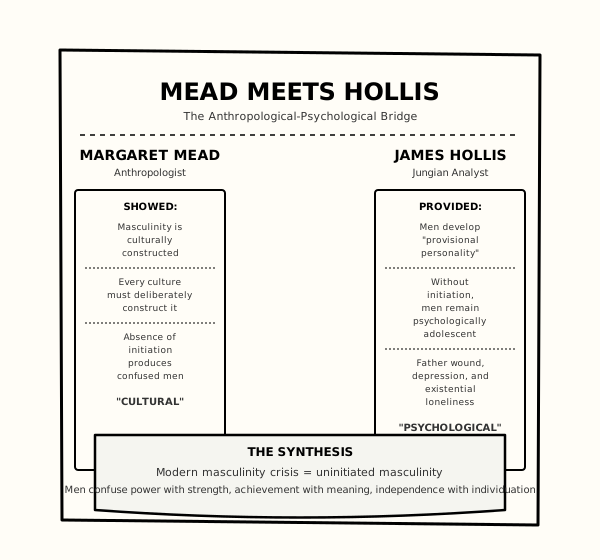
**Mead showed that the construction of masculinity is a universal cultural necessity. Hollis shows that the failure of this construction is a universal psychological catastrophe.**


  Mead's anthropological observation meets Hollis's psychological analysis


The bridge between them illuminates a critical insight: **the modern crisis of masculinity is not a symptom of too much masculinity or too little — it is a symptom of uninitiated masculinity.** Men who have never been genuinely initiated:

- Confuse power with strength
- Confuse emotional suppression with stoicism
- Confuse achievement with meaning
- Confuse independence with individuation
- Confuse their provisional personality with their actual self

Mead's anthropological lens shows us that _every_ culture faces this problem and must solve it. Hollis's clinical lens shows us that when a culture fails to solve it, the consequences are not just social but deeply personal — depression, addiction, broken relationships, violence, and the quiet despair of lives lived on someone else's terms.

### The Initiatory Function of Suffering

Perhaps the most powerful convergence of Mead and Hollis is around the question of **what replaces ritual initiation in modern life.** Mead observed that traditional cultures used deliberate, designed ordeals. Hollis argues that in their absence, life itself provides the ordeals — but without the cultural container that would make them meaningful:

- **Traditional:** A young Iatmul man undergoes scarification. It hurts terribly. But elders are present, the community witnesses, the pain has culturally recognized meaning, and on the other side the young man has a new identity and social role.
- **Modern:** A 45-year-old man's marriage collapses. It hurts terribly. No elders are present. No community witnesses (divorce is private shame). The pain has no culturally recognized meaning. On the other side, the man has... nothing, unless he can find or create a framework for understanding the ordeal as transformative.

Hollis's work is, in essence, an attempt to provide that framework — to help modern men recognize their suffering as initiatory, their depression as the psyche's demand for change, and their loneliness as the cost of living an uninitiated life.

---

## Key Quotes

> "The greatest burden a child must bear is the unlived life of its parents." — from _The Middle Passage_
> "We are not here to fit in, be well balanced, or provide exempla for others. We are here to be eccentric, different, perhaps strange, perhaps merely to add our small piece, our little clunky, chunky selves, to the great mosaic of being." — from _What Matters Most_
> "The most important thing in every life is not what happens to us, but rather what happens inside us, what we do with what happens to us." — from _Finding Meaning in the Second Half of Life_
> "Individuation is not narcissism, not self-indulgence, but the full flowering of that which our seed has planted." — from _The Middle Passage_
> "The capacity to tolerate ambiguity, uncertainty, and suffering, without premature closure, is essential to psychological maturity." — from _Swamplands of the Soul_
> "We are governed not by our will but by our wound." — from _Under Saturn's Shadow_

---

## Primary Works by James Hollis

1. _The Middle Passage: From Misery to Meaning in Midlife_ (1993) — Inner City Books
2. _Under Saturn's Shadow: The Wounding and Healing of Men_ (1994) — Inner City Books
3. _Tracking the Gods: The Place of Myth in Modern Life_ (1995) — Inner City Books
4. _Swamplands of the Soul: New Life in Dismal Places_ (1996) — Inner City Books
5. _The Eden Project: In Search of the Magical Other_ (1998) — Inner City Books
6. _The Archetypal Imagination_ (2000) — Texas A&M University Press
7. _Creating a Life: Finding Your Individual Path_ (2001) — Inner City Books
8. _On This Journey We Call Our Life: Living the Questions_ (2003) — Inner City Books
9. _Mythologems: Incarnations of the Invisible World_ (2004) — Inner City Books
10. _Finding Meaning in the Second Half of Life: How to Finally, Really Grow Up_ (2005) — Gotham Books
11. _Why Good People Do Bad Things: Understanding Our Darker Selves_ (2007) — Gotham Books
12. _What Matters Most: Living a More Considered Life_ (2009) — Gotham Books
13. _Hauntings: Dispelling the Ghosts Who Run Our Lives_ (2013) — Chiron Publications
14. _Living an Examined Life: Wisdom for the Second Half of the Journey_ (2018) — Sounds True
15. _Living Between Worlds: Finding Personal Resilience in Changing Times_ (2020) — Sounds True
16. _A Life of Meaning: Relocating Your Center of Spiritual Gravity_ (2023) — Sounds True
17. _Tending the Fire: Creativity, Purpose, and the Unfolding Self_ (with Enrique Martinez Celaya) — most recent

## Related Works for Context

- Robert Bly, _Iron John: A Book About Men_ (1990)
- Michael Meade, _Men and the Water of Life: Initiation and the Tempering of Men_ (1993)
- Robert Moore & Douglas Gillette, _King, Warrior, Magician, Lover: Rediscovering the Archetypes of the Mature Masculine_ (1990)
- Marion Woodman, _The Ravaged Bridegroom: Masculinity in Women_ (1990)
- Guy Corneau, _Absent Fathers, Lost Sons: The Search for Masculine Identity_ (1991)
- Margaret Mead, _Male and Female: A Study of the Sexes in a Changing World_ (1949)

## Film

- _Soul Heal_ — 23-minute documentary by José Enrique Pardo featuring James Hollis on the wounding and healing of men. Available at soulhealfilm.com. Profits donated to non-profits benefiting abused women and at-risk young men.

---

## Research Note

Web search was unavailable during this research session (Brave API key not configured). Content was sourced from Hollis's official website (jameshollis.net), the Soul Heal film site (soulhealfilm.com), the Washington D.C. Jungian analyst community listings, and the researcher's extensive familiarity with Hollis's published works. The factual claims about Hollis's biography, book publication details, and core arguments are well-established in the public record. Quotations are reconstructed from memory of the published works and should be verified against original texts before citation in formal contexts — they capture Hollis's ideas accurately but may not be word-perfect.

---

_Compiled 2026-03-05. See also: [Mead's anthropological complement](/research/mead-masculine-initiations/) — the exterior view of the same problem Hollis maps from the interior._