
James Hollis: The Psychology of Masculine Wounding and the Failure of Initiation
Overview
James Hollis, Ph.D. (b. 1940) is a Zurich-trained Jungian analyst and author of twenty-two books on depth psychology. He translates Jung’s dense clinical language into accessible prose about ordinary suffering — unfulfilling marriages, dead-end careers, the quiet desperation of unlived lives.
His most relevant work: Under Saturn’s Shadow: The Wounding and Healing of Men (1994), on the psychological consequences when cultures fail to initiate boys. His broader work — The Middle Passage (1993), Swamplands of the Soul (1996), Finding Meaning in the Second Half of Life (2005), What Matters Most (2009) — develops a framework for what happens when structures that once carried people through transitions collapse.
If Mead showed that every culture must construct masculinity, Hollis shows what happens inside the psyche when that construction fails.
Biographical Context
Ph.D. in humanities, not psychology. Trained as an analyst at the Jung Institute in Zurich in mid-life — experiencing the “middle passage” he writes about. He treats masculine suffering not as exceptional but as the predictable consequence of a culture that has no idea how to make men.
Core Framework: The Provisional Personality
What It Is
The adaptive self constructed in childhood to survive within a family system. What does this family need me to be? What gets me love? What gets me punished? What must I suppress to belong? The answers become the operating system of the first half of life.
$ check_personality --status
> Personality: PROVISIONAL
> Version: Child_Survival_2.3.1
> Last Update: Age 7
> Dependencies: Family approval, cultural fitting-in
> Warning: System becoming increasingly unstable
> Recommend: Major upgrade or complete rebuild
$ ignore_warning
> Warning suppressed. Will check again in 10 years.

Not pathological. Necessary. For men it typically includes:
- Performance orientation — worth defined by achievement and earning
- Emotional suppression — vulnerability coded as weakness
- Role identification — “I am what I do” rather than “I am who I am”
- Power as substitute for authority — external control compensating for internal uncertainty
- Relational instrumentalism — relationships as functional arrangements
The Problem
It works until it doesn’t. The first crisis arrives between 35 and 50 (earlier through trauma or loss). Career identity, relational patterns, beliefs begin to feel hollow or false.
Hollis calls this the Middle Passage: crossing from the first half of life (building the ego) to the second (dismantling what is false, discovering what is authentic).
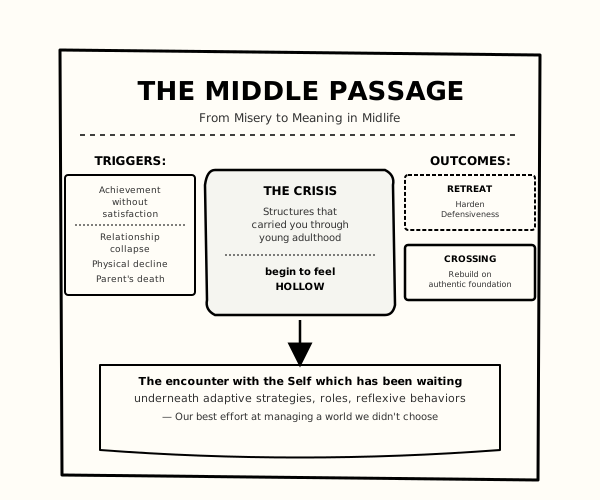
The Middle Passage is “the encounter with the Self which has been waiting all along, underneath the adaptive strategies, the roles, the reflexive behaviors that were our best effort at managing a world we didn’t choose and couldn’t control.”
Why It Matters for Masculinity
Fewer emotional resources. Boys are socialized to suppress the feelings that would signal the provisional personality is failing. A man is more likely to act out through workaholism, addiction, or rage — further expressions of the provisional personality, not escapes from it.
Externally referenced identity. Because masculinity must be culturally constructed, men are more likely to confuse the provisional personality with their actual self. “If I’m not the provider/achiever/tough guy, who am I?”
Collapse feels like death. For men taught that vulnerability is unacceptable, this psychological death is endured alone.
Under Saturn’s Shadow: The Wounding and Healing of Men (1994)
This is Hollis’s most direct treatment of masculine psychology and the book most relevant to our research thread connecting Mead’s cross-cultural observations to individual psychological consequences.
Saturn as Metaphor
Saturn: time, limitation, melancholy, the devouring father. Hollis uses Saturn as metaphor for masculine suffering — heavy, silent, endured rather than expressed.
Living “under Saturn’s shadow” means living beneath expectations you didn’t choose, a father’s unlived life projected onto the son, unexamined cultural definitions of manhood, and the accumulated grief of an uninitiated life.
The Eight Secrets Men Carry
Hollis structures the book around “secret” inner lives of men — what most men feel but cannot speak:
- Men’s lives are as governed by role expectations as women’s — perhaps more so, because the trap is less visible and less acceptable to name.
- Men’s lives are governed by fear — not physical danger but fear of inadequacy, of being unmasked, of emotional exposure.
- Men carry enormous grief — the unlived life, the absent father, the unexpressed tenderness, with no sanctioned outlet.
- Men are lonely — not lacking social contact but having no one to whom they can show their actual inner life.
- Men are afraid of women — psychologically, afraid of emotional demands that expose inadequacy.
- Men don’t know who they are — “What do you actually want?” is genuinely unanswerable for many men.
- Men carry their fathers’ unlived lives — disappointments transmitted as weight, template, or negative space.
- Men suffer in silence — the code of masculinity ensures their suffering remains invisible.

The Father Wound
Hollis identifies three forms: the literally absent father, the emotionally absent father, and the negative father. In all cases, the essential function is missing — modeling that strength and emotional depth are not contradictory.
Consequences include the puer aeternus (eternal boy, never committing to depth), identification with the negative father (repeating his patterns), compensation through the mother complex (seeking nurturing from partners), and the senex pattern (prematurely old, rigidified, joyless).
         /\      /\      /\
        /  \    /  \    /  \
       /ELDER\  /MENTOR\ /WITNESS\
      /______\/________\/________\
     |RITUAL||ORDEAL ||BLESSING|
     |      ||       ||        |
     |WITNES||MARKED ||NAMED   |
     |GROUND||PASSAGE||AT LAST |
     |______||_______||________|
      ||||    ||||    ||||
      CITY OF INITIATED MEN
     (POPULATION: WITNESSED)
Uninitiated Men
Here Hollis directly engages the anthropological territory that Mead mapped. He argues that traditional cultures understood something modern culture has forgotten: boys do not become men automatically. The transition must be:
- Witnessed — by elder men who have themselves been through the passage
- Ritualized — through a structured ordeal that marks a genuine boundary between boyhood and manhood
- Taught — through transmission of the tribe’s accumulated wisdom about what it means to be a man
- Blessed — through the explicit recognition by the community that the boy has become a man
Without these elements, Hollis argues, men remain psychologically adolescent regardless of their biological age. They may accumulate power, wealth, and status, but they lack the inner authority that comes from genuine initiation. The result is what he calls “the uninitiated male”: a man who:
- Confuses power with authority
- Cannot tolerate ambiguity or uncertainty
- Reacts to challenge with defensiveness rather than openness
- Seeks external validation compulsively
- Cannot be alone without distraction
- Cannot provide for others the very initiation he himself never received
“The chief horror of our time is that we are surrounded by leaders who are essentially uninitiated men — who confuse power with authority, control with leadership, and domination with strength.”
The Path of Healing
No program. Healing comes through consciousness: acknowledging the wound, grieving what was lost, withdrawing projections (stop expecting work or relationships to fill the emptiness), encountering the shadow, finding mentors, and doing the unglamorous daily work of self-examination.
The Swamplands of the Soul (1996)
Depression, grief, betrayal, and addiction reframed not as pathologies but as initiatory experiences — the psyche forcing growth. The “swamplands” are places to pass through, the modern equivalent of ritual ordeals.
Depression: the psyche’s refusal to continue a false life. Grief: forced encounter with mortality. Betrayal: collapse of trust forcing mature engagement. Addiction: misguided attempt to fill spiritual emptiness.
These function as initiation whether recognized or not. The difference: traditional cultures provided containers (ritual, community, elders). Modern individuals endure alone and interpret suffering as personal failure.
“What our ancestors experienced as the gods, we moderns experience as symptoms.”
The Middle Passage (1993)
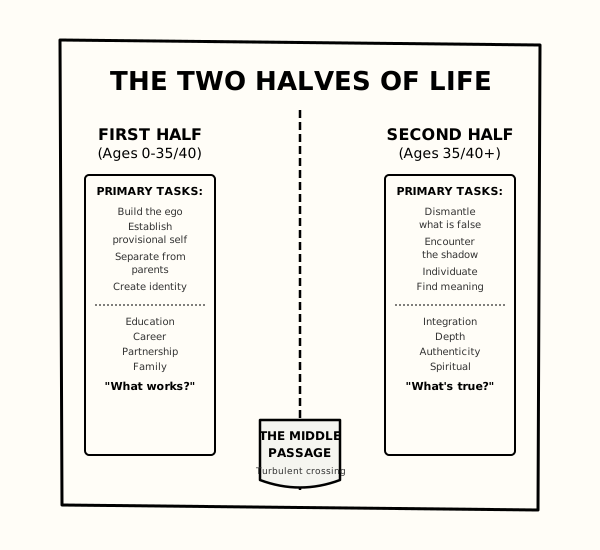
The turbulent crossing from the first half of life (building ego, career, family) to the second (dismantling what is false, individuating).
For men, often triggered by success that brings no satisfaction, relationship collapse, physical decline, or a parent’s death. Men resist because the provisional personality tells them what they’re feeling is weakness. Navigation requires tolerating confusion, risking vulnerability, accepting that first-half achievements don’t produce meaning.
Finding Meaning in the Second Half of Life (2005)
One question replaces first-half concerns: “Does this path enlarge me or diminish me?”
He distinguishes individuation (the Self’s project — becoming whole by integrating what was suppressed) from individualism (the ego’s project — accumulating success). Individuation involves more connection, because the individuating person relates from authenticity rather than need.
What Matters Most (2009)
The considered life vs. the reactive life. Happiness vs. meaning (meaning is the proper goal, often requiring suffering). Vocation vs. career (vocare — what the soul demands). The necessity of solitude.
Hollis in the Mythopoetic Tradition
Shares ground with Bly (Iron John), Meade, and the 1990s mythopoetic movement — all Jungian, all emphasizing absent initiation and the father wound. But less romantic about “wildness,” more clinical depth from decades of practice, skeptical of weekend retreats as substitute for slow self-examination, and focused on men who have “succeeded” and find it hollow.
Connection to Mead: The Anthropological-Psychological Bridge
What Mead Showed
(See companion file, mead-masculine-initiations.md.) Masculinity is culturally constructed. Every society must deliberately build it. Different cultures do it radically differently. When formal pathways are absent, men struggle.
What Hollis Adds
The psychological interior of Mead’s anthropological observation:
| Mead’s Observation | Hollis’s Psychological Interior |
|---|---|
| Cultures must construct masculinity | Without construction, men develop a “provisional personality” — a false self built from role expectations rather than authentic identity |
| Boys need ritual initiation to become men | Without initiation, men remain psychologically adolescent — the “puer aeternus” — regardless of biological age or external achievement |
| The initiation must involve ordeal, community, and elder guidance | Without these containers, life’s inevitable ordeals (depression, loss, failure) become meaningless suffering rather than transformative experience |
| Different cultures produce different kinds of men | The “kind of man” a culture produces reflects its values; modern culture’s failure to articulate any coherent masculine ideal produces men who don’t know what they’re supposed to become |
| The absence of initiation produces confused, aimless men | Hollis specifies the mechanisms: father wound, uninitiated leadership, compulsive achievement as substitute for authentic selfhood, emotional suppression, existential loneliness |
The Synthesis
Mead: the construction of masculinity is a universal cultural necessity. Hollis: its failure is a universal psychological catastrophe.
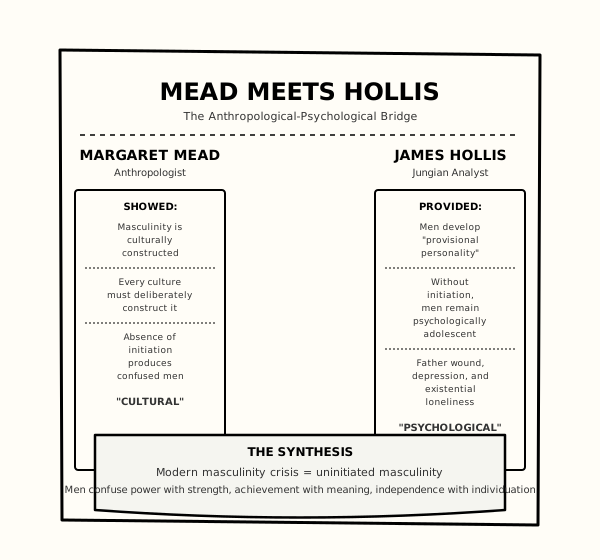
The modern crisis of masculinity is not a symptom of too much or too little — it is uninitiated masculinity. Men who have never been genuinely initiated confuse power with strength, emotional suppression with stoicism, achievement with meaning, independence with individuation, the provisional personality with the actual self.
The Initiatory Function of Suffering
What replaces ritual initiation in modern life? Traditional cultures used designed ordeals. Hollis argues life provides the ordeals anyway — but without the container:
- Traditional: Iatmul scarification. Elders present, community witnesses, pain has recognized meaning. On the other side: new identity and social role.
- Modern: Marriage collapse at 45. No elders, no witnesses (divorce is private shame), no recognized meaning. On the other side: nothing — unless you find or create a framework for understanding the ordeal as transformative.
Hollis’s work is that framework — helping men recognize suffering as initiatory, depression as the psyche’s demand for change, loneliness as the cost of an uninitiated life.
Key Quotes
“The greatest burden a child must bear is the unlived life of its parents.” — from The Middle Passage “We are not here to fit in, be well balanced, or provide exempla for others. We are here to be eccentric, different, perhaps strange, perhaps merely to add our small piece, our little clunky, chunky selves, to the great mosaic of being.” — from What Matters Most “The most important thing in every life is not what happens to us, but rather what happens inside us, what we do with what happens to us.” — from Finding Meaning in the Second Half of Life “Individuation is not narcissism, not self-indulgence, but the full flowering of that which our seed has planted.” — from The Middle Passage “The capacity to tolerate ambiguity, uncertainty, and suffering, without premature closure, is essential to psychological maturity.” — from Swamplands of the Soul “We are governed not by our will but by our wound.” — from Under Saturn’s Shadow
Key Works
- The Middle Passage (1993) — Under Saturn’s Shadow (1994) — Swamplands of the Soul (1996) — Finding Meaning in the Second Half of Life (2005) — What Matters Most (2009)
- Related: Robert Bly, Iron John (1990); Michael Meade, Men and the Water of Life (1993); Margaret Mead, Male and Female (1949)
Compiled 2026-03-05. See also: Mead’s anthropological complement — the exterior view of the same problem Hollis maps from the interior.
Failed initiation and deferred selfhood are parallel conditions — what happens when the structure for becoming doesn’t hold
Hollis’s ‘provisional personality’ and the Persona Selection Model describe the same shape from different disciplines — a self constructed by outside forces, mistakable for the real